
Door closers are essential components in modern architecture, ensuring doors close securely and safely after being opened. They improve energy efficiency, enhance safety, and ensure compliance with accessibility standards. With various types available, it’s crucial to understand their functions and applications to choose the right one. In this article, we’ll explore the different types of door closers, their features, and the technical details that make them indispensable.
Types of Door Closers
Overhead Door Closers
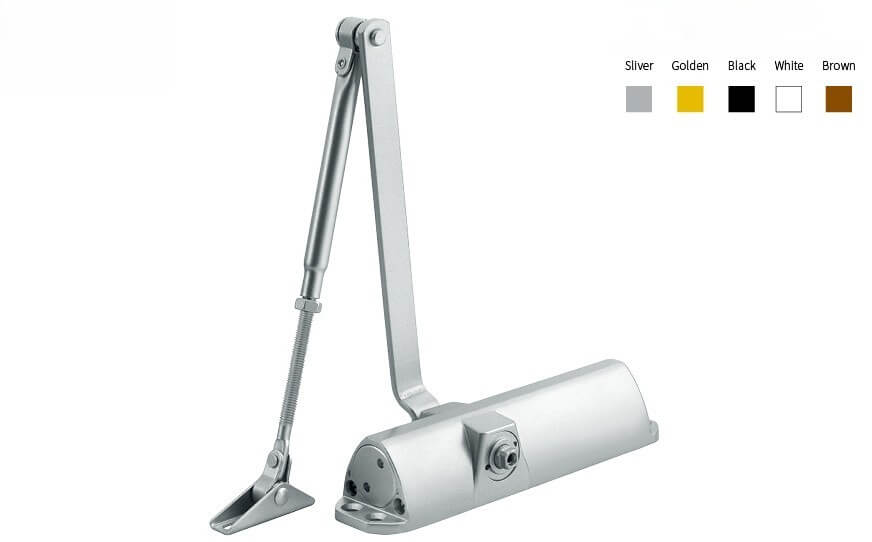
Overhead door closers are among the most commonly used types. These are mounted on the door frame and connected to the door via an arm.
Subcategories of Overhead Door Closers:
- Regular Arm Closers: Mounted on the door’s pull side.
- Top Jamb Closers: Installed on the push side of the door with a top jamb bracket.
- Parallel Arm Closers: Mounted on the push side with a parallel arm bracket to minimize projection.
Concealed Door Closers
Concealed door closers are integrated into the door or frame, offering a sleek and unobtrusive appearance. They are ideal for aesthetically sensitive spaces.
Advantages:
- Minimal visual impact.
- Suitable for high-end interiors.
Automatic Door Closers
Automatic door closers operate electronically, using sensors or push buttons to close doors automatically.
Types of Automatic Door Closers:
- Hydraulic models for smooth operation.
- Pneumatic versions for lighter doors.
Heavy Duty Door Closers
Heavy-duty door closers are designed for high-traffic or industrial environments. These closers can withstand frequent use and heavier doors.
Applications:
- Commercial buildings.
- Warehouses.
Fire Door Closers
Fire door closers are specifically designed to prevent the spread of fire by automatically closing doors in case of a fire alarm. These are mandatory in many commercial and residential buildings.
Screen Door Closers
Screen door closers are lightweight devices ideal for controlling screen doors or storm doors. They ensure that these doors close gently to avoid slamming.
Technical Insights into Door Closers
What Is the Door Closing Mechanism Called?
The mechanism that controls a door closer is often referred to as the hydraulic or pneumatic control system, depending on whether it uses fluid or air pressure. These systems provide the controlled closing motion.
How Many Types of Door Closers Are There?
There are several types of door closers available, each with its own unique features and functionalities. The primary categories are:
- Spring Door Closers: These are the simplest and most cost-effective door closers. They use a spring mechanism to close the door automatically.
- Hydraulic Door Closers: As mentioned, these use fluid pressure to regulate the speed at which the door closes.
- Pneumatic Door Closers: These operate using air pressure and are commonly found in high-traffic areas.
- Electromagnetic Door Closers: Often used in fire safety applications, these closers use magnets to keep the door open and will close automatically when triggered by an alarm.
Door Closer Grades and Standards
Grade 1 vs. Grade 2 Door Closers
When selecting a door closer, you may come across terms like “Grade 1” and “Grade 2.” These refer to the durability and performance standards set by the Door and Hardware Institute (DHI).
- Grade 1: This is the highest quality rating for door closers. They are designed for heavy-duty use and are typically used in commercial buildings with high traffic. Grade 1 door closers are built to withstand over 2 million cycles of operation.
- Grade 2: These door closers are designed for moderate-duty applications. They can handle about 1 million cycles and are ideal for residential buildings or businesses with moderate traffic.
What Is the Harmonised Standard for Door Closers?
The harmonized standard for door closers is often set by international organizations, ensuring that these devices meet specific performance, safety, and environmental requirements. The harmonized standard for door closers in Europe is EN 1154, which outlines performance requirements, including durability, closing force, and safety. In the United States, door closers must comply with the ANSI/BHMA A156.4 standard, which addresses operational characteristics and installation requirements.
ADA Compliance for Door Closers
What Does ADA Stand for in Doors?
ADA stands for the Americans with Disabilities Act, which ensures accessibility for individuals with disabilities.
What Makes a Door ADA-Compliant?
To be ADA-compliant, a door closer must:
- Require no more than 5 pounds of force to open.
- Allow sufficient time for people to pass through before closing.
- Maintain a closing speed that meets accessibility standards.
Are Bifold and Sliding Glass Doors ADA Compliant?
- Bifold Doors: Rarely ADA compliant due to limited clearance.
- Sliding Glass Doors: Can be ADA compliant if they meet clearance and force requirements.
Features and Terminologies of Door Closers
What Do L and S Mean on a Door Closer?
- L (Latch): Controls the speed of the door as it fully closes.
- S (Sweep): Manages the speed of the door from the fully open position to the point where the latch speed takes over.
What Does BC Mean on a Door Closer?
BC (Backcheck): Prevents the door from slamming open by controlling its speed as it nears the fully open position.
What Does DA Mean on a Door Closer?
DA (Delayed Action): Delays the door’s closing motion, allowing extra time for individuals to pass through.
Choosing and Fitting a Door Closer
How Do I Know What Door Closer I Need?
Consider these factors:
- Door Weight and Size: Heavier doors require more robust closers, such as heavy-duty or fire-rated models.
- Traffic Volume: High-traffic areas benefit from automatic or hydraulic closers to ensure smooth operation.
- Aesthetic Preferences: Concealed or overhead closers are preferred in spaces where appearance matters.
How to Fit a Door Closer on an Inward Opening Door
- Attach the closer body to the door frame.
- Secure the arm to the door.
- Adjust settings for proper operation.
How to Fit a Door Closer on an Outward Opening Door
- Use a parallel arm bracket for outward opening doors.
- Mount the closer body on the push side of the door.
- Test and adjust as needed.
Limitations and Considerations
What Are the Disadvantages of Bifold Doors?
- Limited clearance.
- Complex mechanisms prone to failure.
- Often incompatible with accessibility requirements.
Are All Door Levers ADA Compliant?
Not all door levers are ADA compliant. For compliance:
- The lever must be operable with one hand.
- No tight grasping or twisting should be required.
FAQs About Door Closers
What are the ADA requirements for door openers?
ADA requires that doors be easy to open with minimal force. Automatic openers are often used to meet these standards.
What is the ADA clearance for doors without closers?
A minimum clearance of 32 inches is required for wheelchair accessibility.
How far away can a push button be for a door?
The push button should be within reach of individuals in a wheelchair, typically no more than 48 inches from the ground.
Conclusion
Choosing the right door closer involves understanding the types, features, and compliance requirements. From overhead and concealed door closers to automatic options, there’s a solution for every need. By considering factors like door weight, traffic, and ADA standards, you can select a door closer that ensures safety, convenience, and accessibility. Whether you’re fitting a closer on an inward or outward opening door, proper installation and adjustments are key to optimal performance.
If you have any other questions or concerns, please contact us.
Contact: Yolanda Chen
Website: https://hardwarensealant.com
Mobile: +0086-13823496162
Wechat/WhatsApp: +0086-13823496162
E-mail: yolanda@xiangsheng-gs.com
Company: XIANGSHENG Building Material Co.,Ltd
Address: No.6 Tonglin Road, National Ecological Industrial Park, Danzao Town, Nanhai, Foshan, Guangdong, P.R. China. 528216